Recommendations that are evolving
The Swiss recommendations published in 2011 indicated that a healthy adult needed about 0.8 g of protein per kilogram of body weight per day. This value remains useful: it corresponds to the minimum needed to avoid a deficiency in a healthy adult with moderate activity.
But recent knowledge has changed the way this figure is interpreted. Today, a clearer distinction is made between:
- the nutritional minimum, needed to cover basic requirements;
- the optimal intake, which aims to preserve muscle mass, support metabolism, improve satiety, accompany ageing and promote recovery.
In other words, the old recommendations are not “wrong”. They simply answer a different question: avoiding a shortfall. Current recommendations aim more to support long-term health, body composition and vitality.
More protein does not always mean better
The current interest in protein is justified, but it can sometimes be exaggerated. Consuming enough protein is important, especially to preserve muscle mass, better manage satiety and support weight loss.
On the other hand, the idea that you should simply eat “as much protein as possible” is not correct.
Studies show that the benefits increase up to a certain level, then tend to reach a plateau. This means that beyond a certain intake, adding even more protein brings little or no additional benefit for most people.
For many adults, the benefits are already well covered at around 1.0 to 1.6 g/kg/day, depending on lifestyle and goal. Intakes close to 2 g/kg/day mainly concern very active athletes, phases of intensive training or certain specific performance goals.
The goal is therefore not to eat ever more protein, but to consume the right amount, well spread throughout the day, from varied, quality sources.
Why is protein so important?
Proteins are made up of amino acids. Among them, 9 amino acids are considered essential, because the body cannot produce them on its own. They must therefore be provided through the diet.
These essential amino acids contribute in particular to:
- muscle building and repair;
- recovery after exercise or injury;
- maintaining lean mass;
- the production of enzymes, hormones and neurotransmitters;
- supporting the immune system;
- the health of skin, hair and tissues.
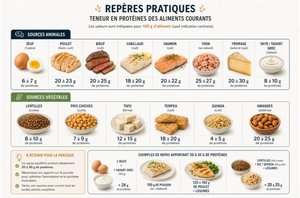
Animal proteins naturally contain all the essential amino acids. Plant proteins can also meet needs, provided the sources are varied: legumes, whole grains, soy, tofu, tempeh, quinoa, nuts and seeds.
Needs according to age, goal and lifestyle
Healthy adult
For a healthy adult, needs are generally around 1.0 to 1.2 g/kg/day.
This range covers daily needs, supports muscle mass and maintains good satiety, without falling into unnecessary excess.
Example: a person weighing 80 kg can aim for about 80 to 95 g of protein per day.
Adolescents
Adolescence is a period of rapid growth, marked by significant hormonal, muscular and bone changes. Protein then plays a structural role.
Needs are generally around 1.0 to 1.5 g/kg/day, depending on age, growth rate and physical activity.
The regularity of intake and the overall quality of the diet are particularly important at this stage.
Pre-menopausal women
In adult women, protein contributes to blood sugar stability, satiety management, the maintenance of muscle mass and energy balance.
An intake of around 1.0 to 1.3 g/kg/day is often appropriate, especially in the case of regular physical activity, fatigue, stress or a body composition goal.
Example: for a woman weighing 75 kg, this represents about 75 to 98 g of protein per day.
Menopausal women
Menopause is accompanied by a drop in oestrogen, which can promote the loss of muscle mass, an increase in body fat and a change in insulin sensitivity.
In this context, protein becomes an important lever to support lean mass, metabolism and satiety.
Needs are often around 1.2 to 1.5 g/kg/day, especially if the goal is to preserve muscle mass or manage weight.
Combining this with regular muscle activity strongly reinforces the benefits.
Seniors 65+
With age, the body becomes less efficient at using protein. This phenomenon, called anabolic resistance, means that muscles respond less well to small amounts of protein.
This is why older people often need a higher intake than the historical minimum.
A range of 1.0 to 1.3 g/kg/day is generally appropriate, with needs potentially rising to 1.5 g/kg/day in cases of frailty, illness, loss of appetite or convalescence.
The goal is to preserve muscle mass, strength, independence and quality of life.
Weight loss
During weight loss, the challenge is not only to lose kilos, but to preserve as much muscle mass as possible.
Protein promotes satiety, helps limit cravings and contributes to maintaining lean mass during calorie restriction.
Needs are generally around 1.2 to 1.6 g/kg/day.
This range is particularly useful when calorie intake decreases, because protein needs do not fall in proportion to calories.
People on GLP-1 treatment
GLP-1 treatments often reduce appetite and can lead to a significant drop in food intake. In this context, it becomes essential to pay attention to the nutritional quality of meals.
An adequate protein intake helps preserve muscle mass during weight loss.
A range of 1.2 to 1.6 g/kg/day may be appropriate, to be adjusted with a healthcare professional according to the medical context.
Athletes and very active people
In athletes, protein supports muscle repair, adaptation to training and recovery.
Needs vary according to the intensity, type of activity, training frequency and goal.
The range generally used is 1.4 to 2.0 g/kg/day.
The highest intakes mainly concern intensive training, strength training, body recomposition phases or periods of high athletic load.
Convalescence, injury or reduced mobility
After surgery, an injury, an illness or during a period of reduced mobility, the risk of muscle loss increases.
Protein supports wound healing, tissue repair and the preservation of lean mass.
Needs are generally around 1.2 to 1.5 g/kg/day, depending on age, state of health and activity level.
In these situations, medical or nutritional support is recommended.
How to spread protein throughout the day?
The total amount of protein is important, but so is its distribution.
Rather than concentrating intake in a single meal, it is better to spread protein across the day: breakfast, lunch, dinner, and possibly a snack.
A balanced meal generally contains 20 to 40 g of protein. This range effectively supports muscle synthesis, satiety and recovery.
A protein-rich breakfast is particularly valuable, as it helps limit muscle loss during the morning and often improves the stability of appetite throughout the day.
Animal or plant protein: do you have to choose?
There is no need to set animal and plant proteins against each other. They can be complementary.
Animal sources such as eggs, fish, poultry, meat, dairy products and seafood are rich in complete protein.
Plant sources such as lentils, chickpeas, beans, tofu, tempeh, quinoa, nuts and seeds provide protein, but also fibre, minerals and beneficial plant compounds.
For a vegetarian or vegan diet, variety is essential in order to cover all the essential amino acids.
Moving from theory to practice
Recommendations in grams per kilogram of body weight are useful, but they can be difficult to apply day to day.
In practice, it is easier to think in terms of meals.
For example, for a person aiming for about 80 to 100 g of protein per day :
- a breakfast with 2 eggs or a Greek yoghurt ;
- a lunch with a main protein source;
- a balanced dinner with protein, vegetables and starches or legumes;
- possibly a snack based on nuts, quark, tofu, hummus or another suitable source.
The goal is to build a coherent food day, without constant calculation or obsession with numbers.
How Allcook helps meet your needs
Allcook meals are designed to provide a significant amount of protein in a simple, balanced and ready-to-eat format.
- Two Allcook meals provide on average 60 to 80 g of protein per day, which already covers a large part of the daily needs of many adults.
- The recipes combine different sources of animal and plant protein, making it possible to provide the 9 essential amino acids within a varied diet.
- For people who are more active, losing weight, recovering or with higher needs, it is possible to supplement with protein portions or protein-rich side dishes.
The aim is not to encourage excessive consumption, but to make protein intake simpler, more regular and suited to real life.
Conclusion
Protein is not just for athletes. It is essential at every stage of life: growth, metabolic balance, muscle maintenance, weight management, recovery, menopause and healthy ageing.
Recommendations have evolved: the threshold of 0.8 g/kg/day remains a minimum baseline, but many situations justify higher intakes, often between 1.0 and 1.6 g/kg/day.
That said, eating ever more protein is not the answer. The benefits reach a plateau: beyond a certain threshold, excess does not necessarily bring more results.
The right approach is to aim for a sufficient intake, spread over the day, with varied, quality sources.
The real question is therefore not: “How can I eat as much protein as possible?”
But rather: “How can I meet my real needs in a simple, balanced and sustainable way?”